The book of Jonah uses the same verb four times, and nobody notices because the objects it attaches to are so unimpressive.
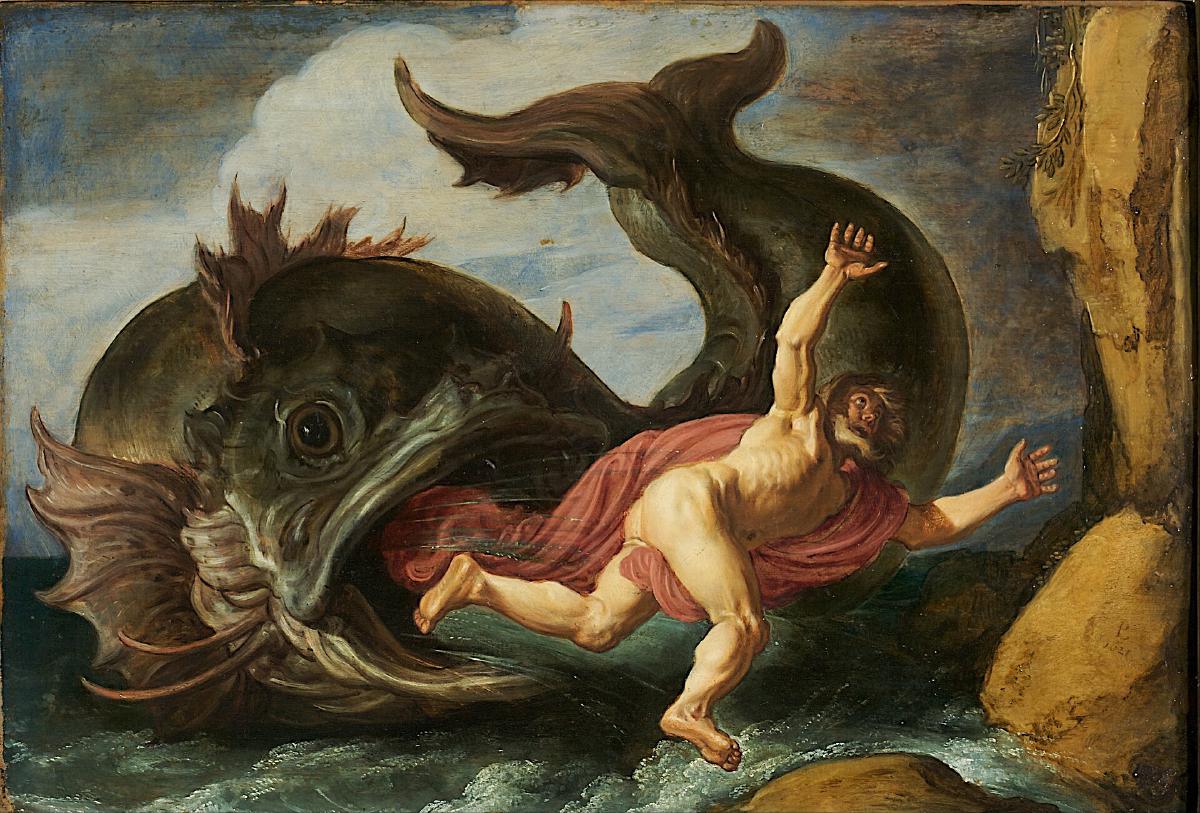
God appoints a great fish (Jonah 1:17). God appoints a plant (4:6). God appoints a worm (4:7). God appoints a scorching east wind (4:8). Same Hebrew verb — manah, to assign, to ordain, to hand something its specific commission — deployed across the whole book on a sea creature, a gourd, an invertebrate, and some weather.
That’s the cast. Those are the instruments. God is running an operation against a fleeing prophet and the entire toolkit consists of a fish, a plant, a worm, and wind.
Which is either an insult or the entire point, depending on how closely you’re reading.
The Direction Nobody Mentions #
Jonah is told to go to Nineveh and cry out against it (1:2). He goes to Joppa instead, finds a ship bound for Tarshish, and pays the fare (1:3).
The detail worth sitting with is that he paid. This isn’t a man swept along by circumstance or confusion about the assignment. He understood the instruction perfectly, calculated the opposite direction, located transportation, and covered the cost himself. Fleeing from the presence of the LORD turns out to have a price, and Jonah is willing to meet it.
Tarshish, as far as anyone can establish, was about as far west as the known world went. Nineveh was east. He didn’t wander off course. He bought a ticket to the furthest reachable point in the exact opposite direction and got on board.
Then he went below deck and fell asleep (1:5).
The storm hits, the sailors panic, every man cries out to his own god, cargo goes overboard — and the prophet of the God who made the sea is unconscious in the hold. The captain has to wake him up and tell him to pray. A pagan ship’s captain, in the middle of a supernatural storm, instructing Israel’s prophet on basic religious practice.
Nobody in the book has a worse day than these sailors, who did nothing wrong, and who end up handling this better than Jonah does.
What the Sea Actually Did #
Jonah tells them to throw him overboard (1:12), which they resist, which is itself remarkable — they row harder instead, trying to save the man who just told them he’s the reason they’re all about to die. When rowing fails they pray, apologize to a God they’ve just met for what they’re about to do, and throw him in (1:14-15).
And the sea goes quiet.
What happens next in the narrative is the fish. But what happens next to Jonah is described in his own words in chapter 2, and the language is not ambiguous.
“The waters closed in over me to take my life; the deep surrounded me; weeds were wrapped about my head at the roots of the mountains. I went down to the land whose bars closed upon me forever” (Jonah 2:5-6).
Read what he’s actually reporting. Not a close call. Not a terrifying moment before rescue arrived. The waters closed in to take my life — completed purpose. Weeds wrapped around his head at the mountain roots, which is as deep as the ancient imagination went. And then the bars of the land closing upon him forever.
That’s not the vocabulary of a man describing a near-drowning. That’s a man describing a drowning.
And two verses earlier: “Out of the belly of Sheol I cried, and you heard my voice” (2:2). Sheol is not a poetic intensifier in Hebrew. It’s where the dead are. Everywhere the word appears, it goes to the same place and stays there.
Which reframes the fish entirely.
The Fish Was Not the Rescue #
The standard reading treats the fish as God’s lifeguard — Jonah is drowning, God dispatches a fish, Jonah is saved from the water and survives inside it for three days.
That reading has a problem it rarely addresses out loud. A fish’s stomach is not a ventilated room. There is no air supply in there, no oxygen, no mechanism by which a man breathes for three days. Every commentator who holds the survival view eventually concedes this and appeals to a sustaining miracle — God kept him breathing, kept him from being digested, kept him lucid enough to compose structured Hebrew poetry while submerged in gastric acid in total darkness.
That’s a defensible position. It’s just worth being honest that it requires a miracle stacked on a miracle, and that nothing in the text describes it.
The simpler reading fits both the physiology and Jonah’s own testimony: he drowned. The sea did exactly what he says it did. And then God appointed a fish to swallow him — not as an ambulance, but as a tomb. Three days and three nights in the belly of a sea creature, sealed, in the dark, dead.
The fish isn’t what saved him from death. The fish is where God put the body.
Why This Matters for What Jesus Said #
Jesus makes exactly one comparison to Jonah, and he’s specific about which part: “For just as Jonah was three days and three nights in the belly of the great fish, so will the Son of Man be three days and three nights in the heart of the earth” (Matthew 12:40).
Under the survival reading, that comparison is loose. Jonah went through something dark and frightening and came out; Jesus died and rose. The parallel works at the level of atmosphere.
Under the drowning reading, the comparison is exact. A body in a sealed place for three days. Then out. Jonah is not an illustration of Jesus’s experience — he’s a type of it, matching at the only point that actually matters.
This also explains why Jesus calls it a sign at all. A prophet having a bad week at sea is not a sign. A dead man walking out after three days is the only sign he ever offered that generation, and he said so in the same breath.
The Poem Was Written by a Dead Man #
Chapter 2 is a thanksgiving psalm, and thanksgiving psalms have a fixed shape: they report a rescue that has already happened, in the past tense, from the far side of it.
Jonah’s follows the form precisely. “I called out to the LORD, out of my distress, and he answered me” (2:2). “You brought up my life from the pit” (2:6). Answered. Brought up. Completed action, recounted afterward by someone standing on the other side of the thing he’s describing.
He’s not praying for deliverance. He’s reporting one.
Which resolves the question of how a man composes poetry with no air, no light, and no space to think. He didn’t. The poem is what he had to say once God had already done the raising — recited from inside the fish before it vomited him onto dry land (2:10), or set down afterward on the beach, but either way spoken by a man describing his own death in the past tense because it was already behind him.
“Salvation belongs to the LORD” (2:9) is the last line. It reads differently when the man saying it is someone who had recently stopped existing.
The Worm Gets the Last Word #
Here is where the book becomes almost unbearable.
Jonah goes to Nineveh. He preaches eight words of judgment. The entire city repents — king, nobles, population, livestock, the whole apparatus of a brutal empire in sackcloth (3:5-9). God relents.
And Jonah is furious (4:1). Not disappointed. Angry enough to tell God he’d rather die than watch this, which he says out loud, in chapter 4, having personally been dead already and having personally been raised from it.
So God appoints a plant for shade, and Jonah is delighted — the text says he was “exceedingly glad because of the plant” (4:6), the only moment of joy recorded for him in the entire book. A gourd. Not Nineveh’s repentance. Not his own resurrection. A shrub.
Then God appoints a worm. The plant withers. God appoints the east wind. Jonah, sunstruck and miserable, asks to die a second time (4:8).
The man who drowned in the Mediterranean, spent three days in a sea creature, and was raised from the dead by the God he was running from — this man wants to die over a dead houseplant.
That’s the joke. It’s also the indictment, and God delivers it without softening anything: “You pity the plant, for which you did not labor, nor did you make it grow… And should not I pity Nineveh, that great city, in which there are more than 120,000 persons who do not know their right hand from their left, and also much cattle?” (4:10-11).
The book ends on that question. Jonah never answers it. Scripture doesn’t tell us whether he ever did.
What the Four Appointments Have in Common #
Fish, plant, worm, wind.
Not one of them is impressive. Not one required anything from Jonah — no cooperation, no faith, no permission. Each was assigned a single task and performed it with total precision at the exact moment required, and between them they buried a prophet, raised him, comforted him, and dismantled him.
This is the same category of instrument as ravens under direct orders to carry bread to a brook (1 Kings 17:4), or a jar of flour that produced exactly enough and never a handful more. God’s toolkit throughout Scripture is conspicuously unimpressive and conspicuously exact. Nothing in it is wasted. Nothing in it is decorative. A worm gets a commission and executes it perfectly.
What the toolkit cannot do is change what a man wants.
The fish could carry Jonah’s body. The plant could shade his head. The worm could kill the plant and the wind could scorch him, and all four performed flawlessly — and at the end of the book Jonah is still sitting east of the city, still angry, still wishing he were dead, still unable to extend to 120,000 strangers the mercy that had personally raised him from the sea floor.
He had received more than he could bear and less than he wanted. He’d been given his life back and remained furious that someone else got theirs.
The question God leaves hanging at the end of chapter 4 was never really about Nineveh. It was about whether a man who has personally been rescued from death can tolerate watching it happen to someone he’d rather see destroyed.
That question is still hanging. It was left open on purpose.