The Jawbone and the Thirst #
The strongest man who ever lived killed a thousand soldiers with a bone he picked up off the ground, and then almost died because he was thirsty.
Both events are in the same paragraph. Judges doesn’t treat that as a contradiction, and the fact that it doesn’t is the whole point of these two chapters.
What He Wanted #
Samson was set apart before he was conceived. An angel announced him, placed him under a Nazirite vow from the womb — no wine, no contact with the dead, no razor on his head — and specified his assignment: he would begin to deliver Israel from the Philistines.
Here are the first words Scripture records him saying, as an adult, to his parents:
“I have seen a woman in Timnath of the daughters of the Philistines: now therefore get her for me to wife” (Judges 14:2).
His parents object on covenant grounds — is there really no woman among your own people? His answer doesn’t engage the objection at all: “Get her for me; for she pleaseth me well” (14:3). The King James renders the Hebrew more literally in the margin: she is right in my eyes.
Remember that phrase. The text is going to come back for it, and when it does, it will cost him everything.
There’s a narrator’s aside two verses later that has troubled commentators for centuries: his parents didn’t know “that it was of the LORD, that he sought an occasion against the Philistines” (14:4). Scripture is saying God was working through this. It does not say God approved of it, and it does not resolve the tension between a man pursuing exactly what he wanted and that pursuit serving a purpose he wasn’t thinking about. The verse states it and moves on. This piece will do the same, because manufacturing a tidy explanation for it would be dishonest to a text that declined to provide one.
Honey From a Corpse #
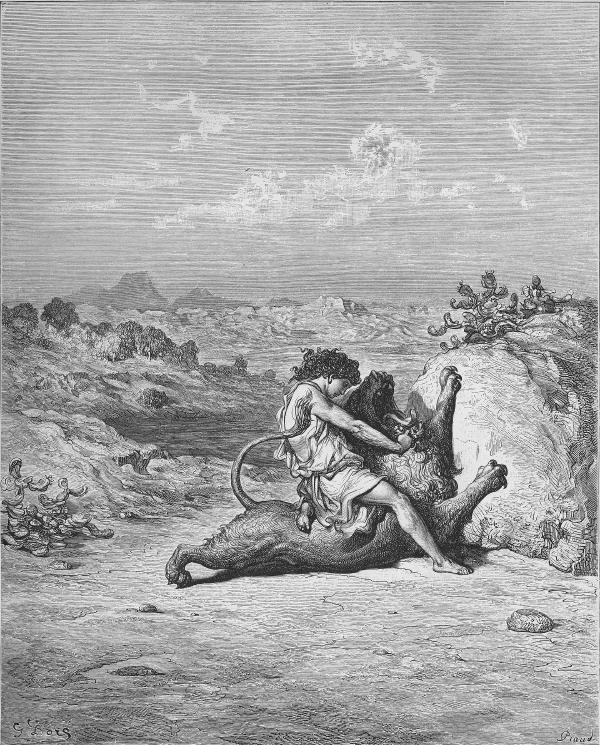
On the road to Timnath, a young lion roars at him. The Spirit rushes on him and he tears it apart barehanded — and then, the text notes, “he told not his father or his mother what he had done” (14:6).
Some time later he comes back the same way and turns aside to look at the carcass. Bees have made a hive in it. There’s honey.
“And he took thereof in his hands, and went on eating, and came to his father and mother, and he gave them, and they did eat: but he told not them that he had taken the honey out of the carcase of the lion” (14:9).
A Nazirite may not go near a dead body. Not a stranger’s, not an animal’s, not his own father’s or mother’s — Numbers 6:6-7 is explicit and makes no exceptions for family or convenience. Samson reaches into one with both hands, scoops out food, eats it while walking, and hands some to his parents without mentioning where it came from.
The first breach of the vow he never chose is casual, concealed, and involves dessert.
Thirty Men and a Riddle #
At the wedding feast, Samson proposes a wager to the thirty Philistine companions assigned to him. If they solve his riddle in seven days, he owes them thirty linen garments and thirty changes of clothes. If they can’t, they owe him.
The riddle: “Out of the eater came forth meat, and out of the strong came forth sweetness” (14:14).
It is unsolvable. Not difficult — unsolvable. The answer depends entirely on a private event that had no witnesses, which Samson had specifically told nobody about, twice. He has wagered a substantial sum on a puzzle he engineered to be unanswerable.
By day four they’re desperate enough to threaten his wife and her family with fire if she doesn’t extract the answer. She weeps in front of him for the rest of the week. On the seventh day he tells her, and she tells them.
They deliver the answer just before sunset, phrased as a question: “What is sweeter than honey? and what is stronger than a lion?” (14:18).
And Samson’s reply reveals something that’s going to matter enormously later: “If ye had not plowed with my heifer, ye had not found out my riddle.”
He understands betrayal perfectly. He recognizes it immediately, identifies the mechanism precisely, and names it out loud — the woman closest to him was used as the instrument to extract what he’d told no one else.
Hold onto the shape of what just happened, because it is going to happen again, and the second time it will cost him everything.
Philistines want information only Samson has. They can’t get it from him directly. So they apply pressure to the woman sleeping beside him — here, a threat to burn her and her father alive (14:15). She turns that pressure on him as tears, sustained for days, until he breaks and tells her. She delivers it to them immediately.
Threat applied to the woman. Tears applied to the man. Secret extracted. Every element of it.
He watched that entire sequence execute against him, understood it well enough to describe the mechanism in a single sentence of contempt, and paid for it with thirty lives in Ashkelon. He will encounter the identical operation in twenty years and not defend against it at all.
To pay the debt, he goes down to Ashkelon, kills thirty men, takes their clothing, delivers it to the winners, and goes home to his father’s house angry (14:19).
Thirty men died to settle a wordplay dispute. Judges reports it in a single verse and offers no comment.
Three Hundred Foxes #
While Samson is off being angry, his wife is given to his best man.
His response is not proportionate, and it is not brief. He catches three hundred foxes, ties them tail to tail in pairs, fixes a torch between each pair, lights the torches, and releases them into the standing Philistine grain (15:4-5).
Pause on the logistics. Three hundred foxes, caught alive. That’s not a fit of rage — that’s weeks of work. Every step of it required sustained, patient, deliberate effort toward a single goal: burning the harvest of the entire region because of a marriage grievance.
The grain burns. The vineyards and olive groves burn with it.
The Philistines respond by burning his wife and her father alive — the exact fate she’d been threatened with at the wedding, arriving anyway, delivered by the people who threatened it.
Samson responds by attacking them “hip and thigh with a great slaughter” (15:8).
Nobody in this sequence ever chooses to stop. Every act of vengeance produces the next one with mechanical reliability, and the escalation only ends when one side runs out of capacity.
His Own People Come to Arrest Him #
The Philistines camp in Judah. The men of Judah ask why. The answer: to bind Samson.
Three thousand men of Judah then go down to the rock where Samson is living — not to defend him, not to rescue him. To hand him over.
Their opening line: “Knowest thou not that the Philistines are rulers over us? what is this that thou hast done unto us?” (15:11).
Read that again. Israel’s appointed deliverer is being asked, by three thousand of his own countrymen, what he thinks he’s doing disturbing the occupation. They have so thoroughly accommodated themselves to Philistine rule that the man sent to end it registers as a public nuisance.
He agrees to be bound on one condition — that they won’t kill him themselves. They tie him with two new ropes and bring him up.
A Pun on a Battlefield #
The Philistines shout in triumph when they see him coming. The Spirit rushes on him. The ropes become like burned flax and fall off his hands.
He finds a fresh jawbone of a donkey, picks it up, and kills a thousand men with it (15:15).
Fresh. Which means it came from a recently dead animal. Which is the second corpse the vow forbade him to touch, gripped in his hand throughout the single greatest feat of individual strength recorded anywhere in Scripture. The vow is being violated in the middle of the miracle, and the miracle proceeds regardless.
Then, standing there, he composes a joke.
“With the jawbone of an ass, heaps upon heaps, with the jaw of an ass have I slain a thousand men” (15:16).
It works better in Hebrew, where hamor means donkey and homer means heap — the line is a pun, delivered by a man standing on a thousand bodies, about the animal whose jaw he used to make them.
And Then He Was Thirsty #
“And he was sore athirst, and called on the LORD, and said, Thou hast given this great deliverance into the hand of thy servant: and now shall I die for thirst, and fall into the hand of the uncircumcised?” (15:18).
This is the first time in two full chapters that Samson speaks directly to God.
Not before the lion. Not at the wedding. Not while catching three hundred foxes, or burning a region’s food supply, or being handed over by his own tribe, or killing a thousand men. The first recorded prayer of the strongest man alive arrives immediately after his greatest victory, and it is about water.
There’s no rebuke. God splits open a hollow place in the ground, water comes out, he drinks, and his spirit returns and he revives (15:19).
The man who could not be bound by new ropes was going to be finished by dehydration. The gift was never the same thing as the man. It operated on demand, at enormous scale, entirely independent of his character, his obedience, or his intentions — and it did absolutely nothing about the fact that he was an ordinary human being with an ordinary body and ordinary appetites that had been running his decisions since the first sentence he spoke.
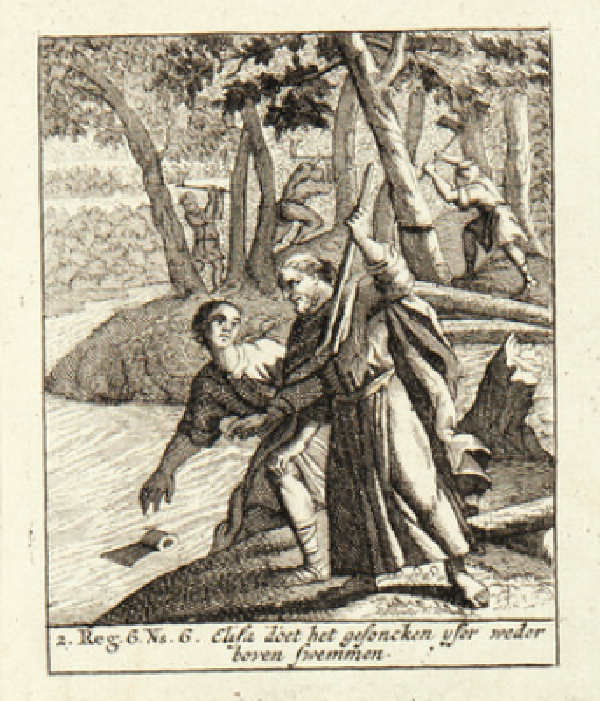
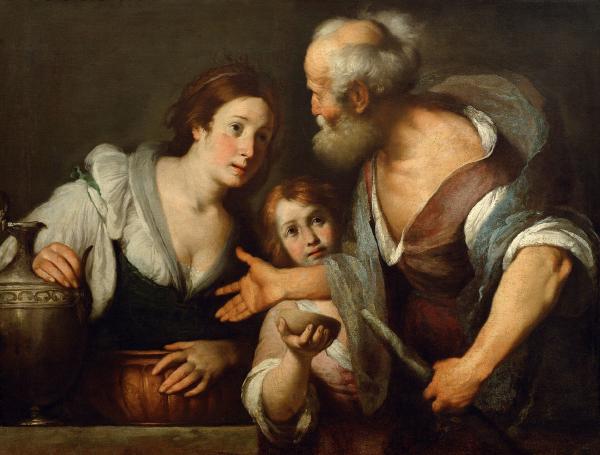
That’s the thing worth sitting with. Everywhere else, God’s instruments do exactly what they’re assigned — ravens carry bread and nothing else, a jar produces one meal’s worth and never more, a stick gets thrown at a river and iron comes up to meet it. None of them wanted anything. Samson wanted a great deal, constantly, and got it, and the power worked anyway.
Twenty Years #
The chapter ends on a sentence that quietly reframes everything before it.
“And he judged Israel in the days of the Philistines twenty years” (15:20).
Twenty years, compressed into eleven words.
Go back through what’s actually recorded. A wedding he wanted. A riddle he rigged. A debt he paid with thirty corpses. A harvest he burned over a personal grievance. A slaughter that answered a slaughter that answered a slaughter. Not one campaign. Not one act of national deliverance undertaken on purpose. Every single recorded event in these two chapters was personal, reactive, and about something Samson wanted or something Samson had lost.
And Scripture calls it judging Israel.
The commission announced before he was conceived was being fulfilled the entire time. It was just never once being intended — and the gap between those two things held open for twenty years without anyone, including Samson, apparently noticing it was there.
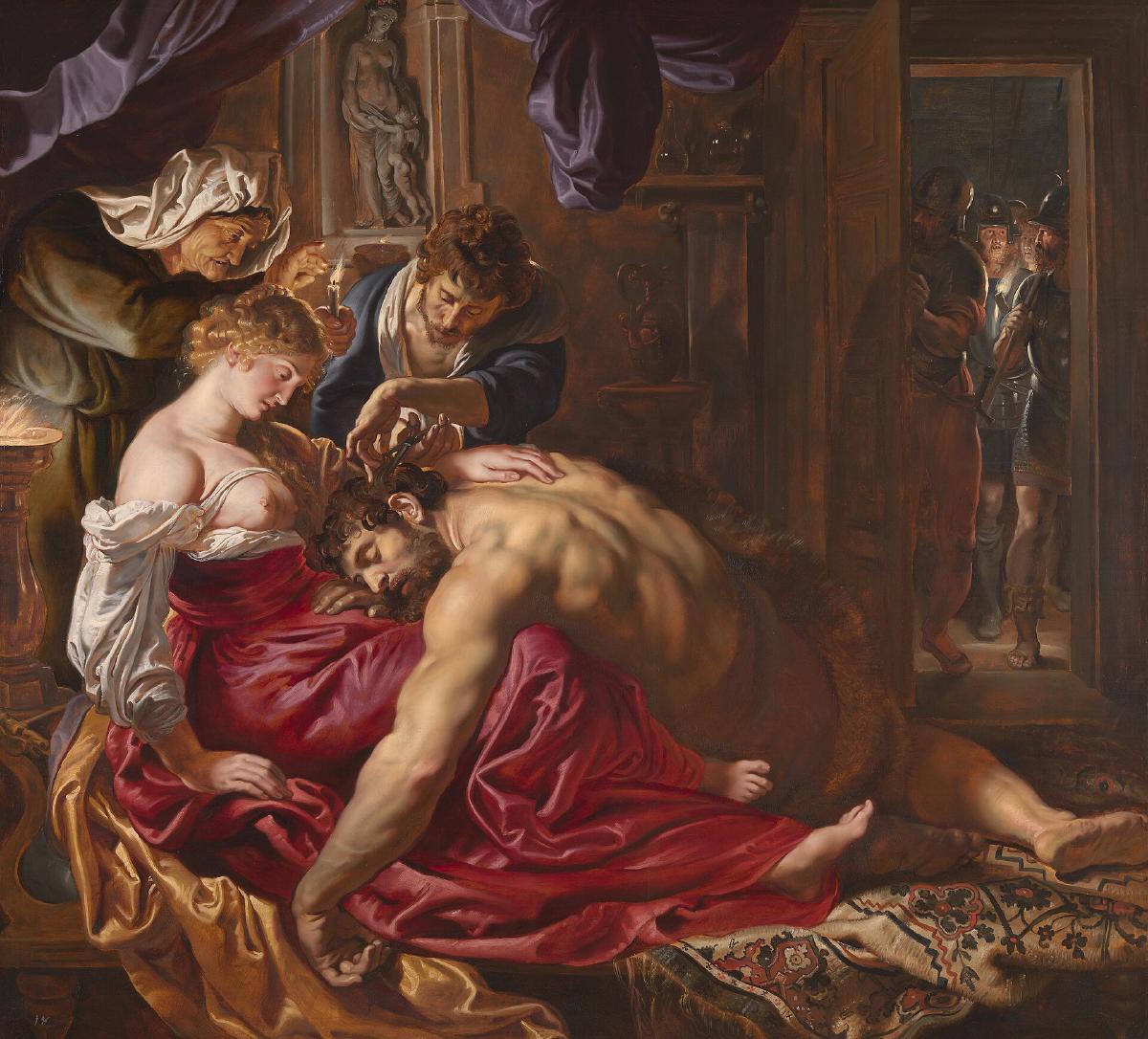
The gap closes in the next chapter. It closes the same way it opened — a Philistine offer, a woman beside him, a secret he was never supposed to give away — on a night he is completely certain nothing has changed.