He Did Not Know #
It had already happened to him once.
Twenty years earlier, at his own wedding feast, the Philistines wanted something only Samson knew. They couldn’t get it from him, so they went to the woman beside him and threatened to burn her and her father alive if she didn’t produce it. She turned that pressure on Samson as tears, every day, until he broke and told her. She handed it over the same afternoon.
He knew exactly what had been done to him. He said so out loud, with contempt, in one sentence: “If ye had not plowed with my heifer, ye had not found out my riddle” (Judges 14:18).
Correct diagnosis. Named mechanism. Thirty men dead in Ashkelon to cover the loss.
Then the Philistines ran the identical operation a second time, and he walked into every step of it.
Forty Miles With a City Gate #
Chapter 16 opens with Samson visiting a prostitute in Gaza — a Philistine city, deep in hostile territory, with no stated purpose for the trip beyond the visit itself (16:1).
Word gets around. The men of Gaza shut the city gate and set an ambush, planning to kill him at dawn. It’s a sound plan. The gate is the only way out.
Samson gets up at midnight, takes hold of the doors of the city gate, pulls them up along with the two posts and the bar, puts the whole assembly on his shoulders, and carries it to the top of a hill facing Hebron (16:3).
Hebron is roughly forty miles away, uphill.
He did not need to do that. Removing the gate was sufficient to escape. Carrying it forty miles into the hill country and depositing it where the Philistines would eventually have to come and look at it was a statement — and the statement was that nothing they had could hold him.
He was right about that, and it is the last time in the chapter he is right about anything.
Hold both halves of that scene together, because the rest of the chapter depends on it: the strength is completely intact. The judgment is completely absent. A man who can walk off with a fortified city’s gate went into that city, past the walls of a people actively looking for a chance to kill him, because he wanted a woman there — and the strength came out to cover the appetite, the way it always had.
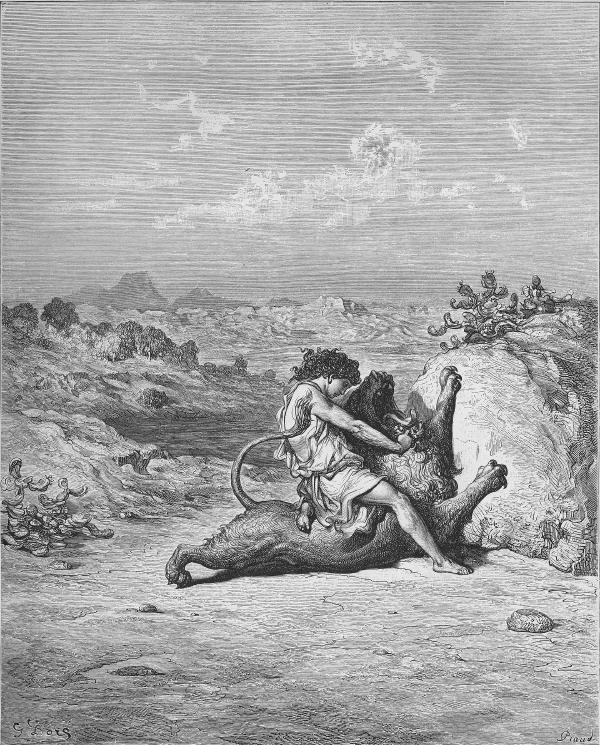
That’s the arrangement he’s been living under for twenty years. Twenty years earlier it was a woman at Timnath and the strength killed a lion on the road. Now it’s a woman in Gaza and the strength walks off with the gate. The appetite sets the direction, the power cleans up the consequences, and nothing in that loop has ever once required him to reconsider anything.
Which is why, when a Philistine woman in the valley of Sorek starts asking how he might be subdued, he has no reason to believe this one will go differently.
The Same Offer, Larger #
“And it came to pass afterward, that he loved a woman in the valley of Sorek, whose name was Delilah” (16:4).
Her name is recorded. His first wife’s never was. This is the only woman in the cycle Scripture says he loved, and the only one it bothers to identify — the text gives her a name at the exact moment it’s about to tell you what she does with it.
The lords of the Philistines come to her with the same proposal they used before, scaled up: “Entice him, and see wherein his great strength lieth… and we will give thee every one of us eleven hundred pieces of silver” (16:5). Five lords. Five thousand five hundred pieces, for one secret.
The first time, the leverage was a threat. This time, it’s a payment. That’s the only variable that changed.
She Does Not Hide Any of It #
Here is what makes chapter 16 nearly unbearable to read, and it isn’t Delilah’s deception. It’s how little deception she bothers with.
Her opening line: “Tell me, I pray thee, wherein thy great strength lieth, and wherewith thou mightest be bound to afflict thee” (16:6).
She asks how to subdue him. Out loud. In the first sentence. There is no seduction narrative here, no slow manipulation, no concealed intent — the Philistine lords’ proposal and Delilah’s question use nearly identical wording, and she delivers it the way a person reads from a form.
He tells her seven fresh bowstrings will do it. She binds him with seven fresh bowstrings while men wait in the inner chamber, then shouts, “The Philistines be upon thee, Samson!” (16:9). He snaps them.
He now has complete information. She asked how to subdue him, applied the answer, and summoned armed men. There is nothing left to infer.
Her response to being caught: “Behold, thou hast mocked me, and told me lies” (16:10). She reframes his survival as a personal offense against her.
He tells her new ropes. She uses new ropes. Men in the chamber. Same shout. He snaps them.
He tells her to weave his hair into the loom. She weaves his hair into the loom. Same shout. He pulls the loom out of the ground and walks away with it.
Three times. Three demonstrations, in the same room, with witnesses hiding in it, of exactly what she intends to do with anything he tells her. The first betrayal took her predecessor seven days and required a death threat to set in motion. This one Delilah performs openly, three times, and he stays for a fourth.
The Sentence That Finally Works #
“How canst thou say, I love thee, when thine heart is not with me? thou hast mocked me these three times, and hast not told me wherein thy great strength lieth” (16:15).
She converts his self-preservation into evidence that he doesn’t love her. Not a threat — an accusation. And she doesn’t deliver it once: “she pressed him daily with her words, and urged him, so that his soul was vexed unto death” (16:16).
The same tactic that worked at the wedding, twenty years earlier, applied by a different woman toward a different end for a larger payment. Daily pressure until he can’t stand it anymore.
“And he told her all his heart” (16:17).
And what he tells her is the thing from before he existed — the angel in the field, the vow his mother received while he was not yet conceived: “There hath not come a razor upon mine head; for I have been a Nazarite unto God from my mother’s womb.”
It’s the only time in the entire cycle Samson references his own commission. He has never once mentioned Israel, never mentioned the deliverance he was appointed to begin, never spoken of the vow he’s been quietly violating since he scraped honey out of a lion’s carcass. The single occasion he invokes any of it is as a confession, in bed, to the woman he has personally watched attempt to deliver him to his enemies three times in a row.
He gave away the one thing that had never been his to give — because someone he loved kept asking, and kept implying that refusing was a failure of love.
He Did Not Know #
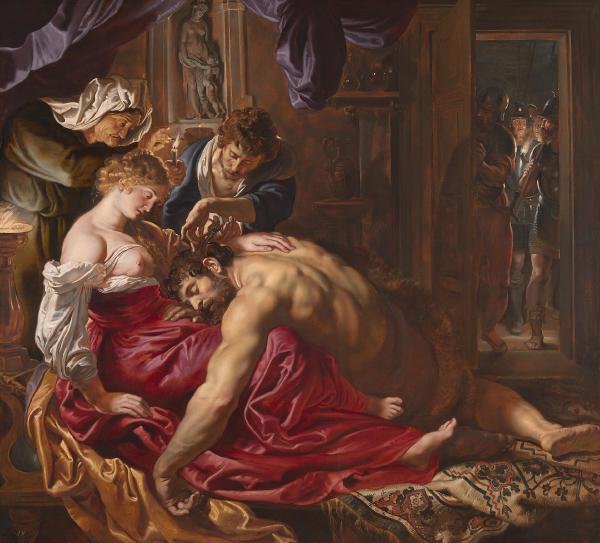
She has his head shaved while he sleeps on her knees. Then the fourth shout, identical to the other three: “The Philistines be upon thee, Samson.”
“And he awoke out of his sleep, and said, I will go out as at other times before, and shake myself” (16:20).
Same confidence. Same posture. Same expectation, built on twenty years of uninterrupted evidence, that he would stand up and whatever was holding him would fall off like it always had.
Then the narrator says the thing that ends the story, in four words:
He wist not that the LORD was departed from him.
He did not know.
Not that he had been warned and ignored it. Not that he gambled and lost. He did not know. Whatever had actually been doing the work left quietly, without announcement, at some point while he slept — and the man it left woke up and made exactly the plan he’d always made, with total assurance, and nothing behind it.
The strength was never his. It had been on loan for twenty years, and the departure was silent, and he found out the way everyone finds out: by reaching for it.
They Took His Eyes First #
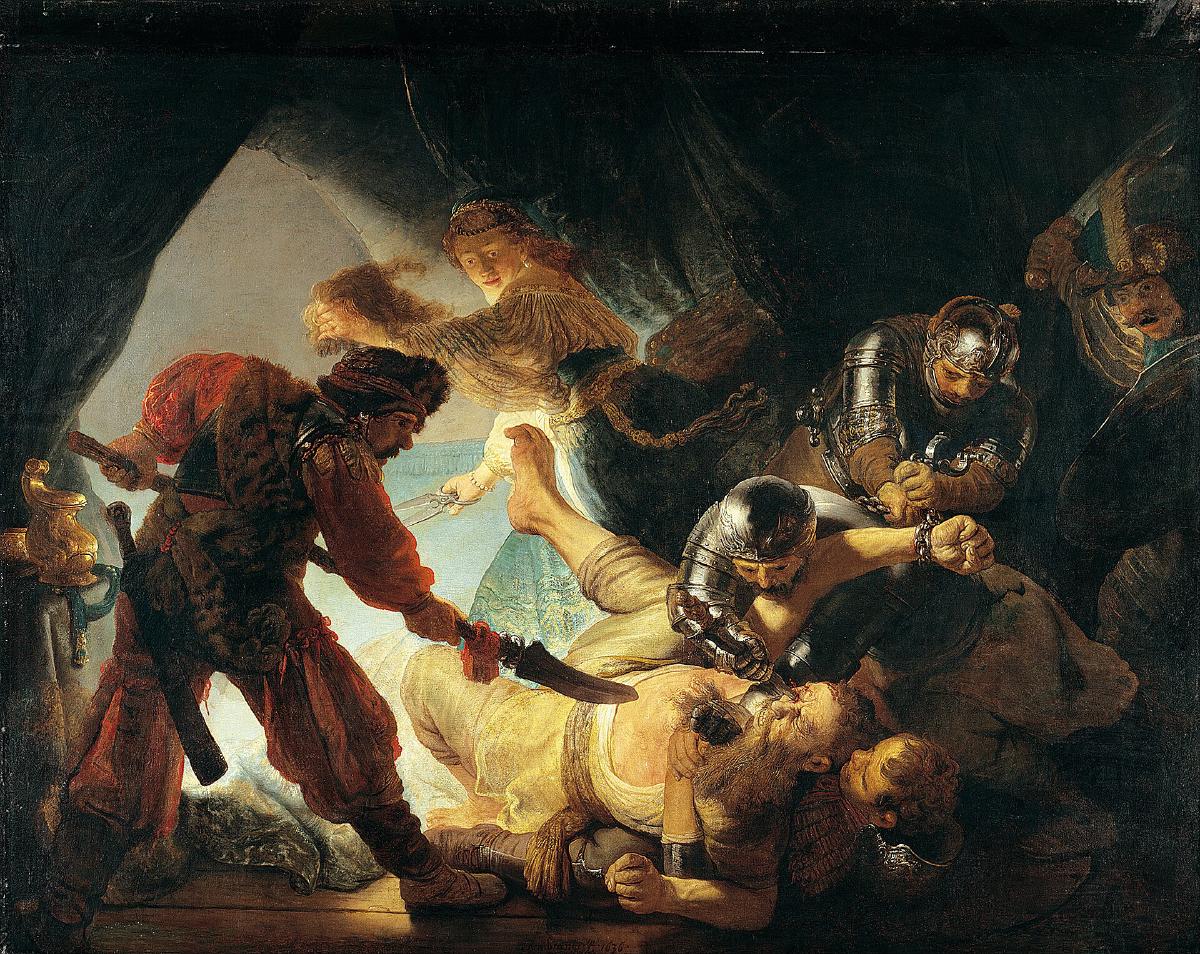
“But the Philistines took him, and put out his eyes” (16:21).
That is the first thing they do. Before the bronze fetters, before the prison, before the grinding — the eyes.
Go back to the first words Samson ever speaks in Scripture, as an adult, about the Philistine woman at Timnath: she is right in my eyes (14:3). Everything that follows in twenty years proceeds from something his eyes wanted. The wedding. The riddle. The wife given away. The foxes. The prostitute in Gaza. Delilah in the valley of Sorek.
The Philistines removed the organ that had been steering him since his first sentence, and it took them exactly one verse.
Then: bound in bronze, grinding grain in the prison house. Mill work was what you assigned to animals and slaves. Israel’s appointed deliverer, blind, doing livestock labor for the nation he had been set apart before conception to begin delivering Israel from.
The Line Nobody Notices #
“Howbeit the hair of his head began to grow again after he was shaven” (16:22).
The narrator drops it in and moves straight on to the Philistine victory festival, offering no comment and no explanation.
It grew back the way hair grows back. Slowly, without announcement, while he was blind and chained and grinding, and nobody watching had any reason to think about it — including, presumably, Samson.
Note what the verse doesn’t say. It doesn’t say his strength returned. The hair was never the mechanism; it was the sign of a vow, and the vow had been broken repeatedly for two decades before anyone put scissors near him. What departed in verse 20 was not a haircut. What’s growing back in verse 22 is just hair.
The Last Prayer #
Three thousand people on the roof. The lords assembled below, sacrificing to Dagon and crediting him with the capture (16:23-24). Samson brought out to perform for them, led by the hand by a boy because he can’t see where he’s going.
He asks the boy to let him feel the pillars.
“O Lord GOD, remember me, I pray thee, and strengthen me, I pray thee, only this once, O God, that I may be at once avenged of the Philistines for my two eyes” (16:28).
Read what he actually asks for.
Not for Israel. Not for the commission announced to his mother before he was conceived. Not forgiveness, not restoration, not the deliverance he was born to begin. He asks to be avenged for his eyes — the specific thing that was taken from him personally, in exchange for the thing he had personally given away.
It is a prayer for revenge, and it is the second prayer he ever prays. The first was about water.
God answers it.
“So the dead which he slew at his death were more than they which he slew in his life” (16:30).
Twenty years of judging Israel, and the most effective single act of the commission happens after he has lost his strength, his sight, his freedom, and the woman he loved — executed in a building he cannot see, for a reason that has nothing to do with the assignment, by a man asking for personal vengeance.
What Hebrews Does With Him #
Centuries later, a letter writer lists the heroes of Israel’s faith — Gideon, Barak, Samson, Jephthah, David, Samuel, and the prophets (Hebrews 11:32).
Samson. By name. In that company. No qualification, no asterisk, no acknowledgment of the honey or the riddle or the foxes or Delilah or the fact that his last recorded words were a request for payback.
Scripture doesn’t explain this, and any explanation offered here would be manufactured.
Where They Buried Him #
The chapter has one verse left, and almost nobody reads it.
“Then his brethren and all the house of his father came down, and took him, and brought him up, and buried him between Zorah and Eshtaol in the buryingplace of Manoah his father” (16:31).
They came down to Gaza. They dug him out of a collapsed temple full of Philistine dead, carried him forty miles back up into the hill country, and buried him in his father’s grave — between Zorah and Eshtaol.
That is the exact patch of ground where the whole thing started.
Between Zorah and Eshtaol is where the Spirit first began to move him, in a place called Mahaneh-dan, before he had done anything or wanted anything (Judges 13:25). It’s within walking distance of the field where an angel appeared to a woman nobody bothered to name and told her she’d have a son who would begin to deliver Israel.
Begin.
The commission came with that limit attached before he was conceived, and it held. He never finished it. He never really tried to. He spent twenty years pursuing what was right in his own eyes, and the deliverance happened around him and through him and largely despite him, and when it was over his family carried what was left of him back to the field where it was announced and put him in the ground beside his father.
The angel who delivered the commission had refused to give a name, saying only that it was beyond understanding.
Some of what he set in motion is too.