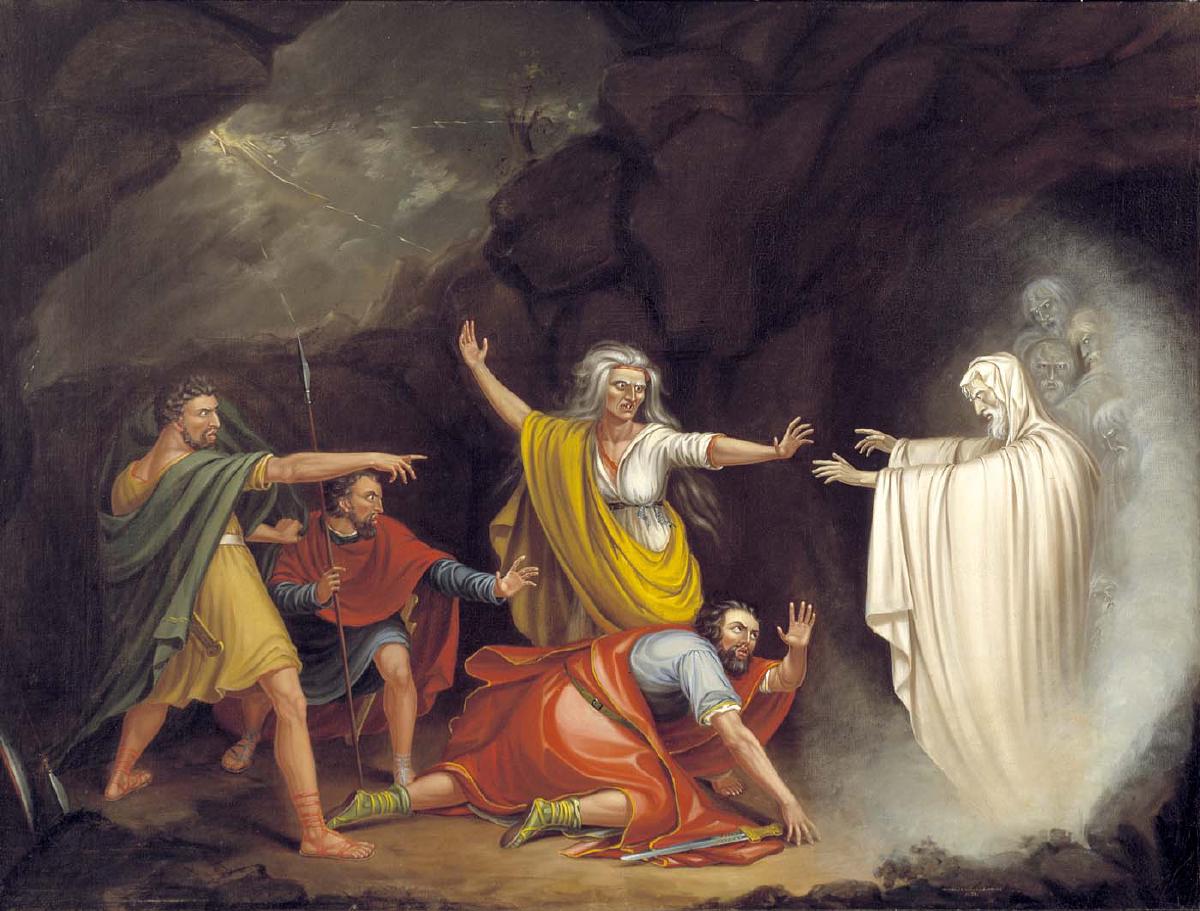
The most terrifying sentence in the Saul narrative is one he says about himself, and he gets it exactly right.
“I am sore distressed; for the Philistines make war against me, and God is departed from me, and answereth me no more, neither by prophets, nor by dreams” (1 Samuel 28:15).
That is a correct diagnosis. Complete, accurate, first-person. He knows what has happened, knows when it happened, knows what it means. There is no confusion operating anywhere in that sentence.
He delivers it at night, in disguise, in the house of a medium he had personally outlawed, having traveled through enemy-held territory to get there.
The diagnosis was right. Everything he did with it was wrong.
The Other Man the Spirit Left #
There is one other place in Scripture where the departure of God’s Spirit from a specific man is stated this plainly.
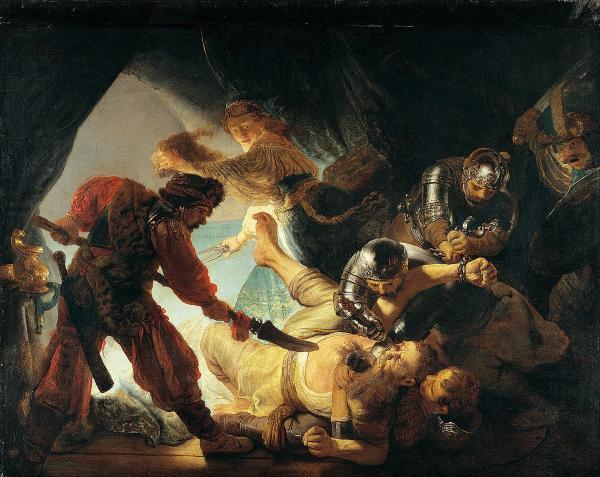
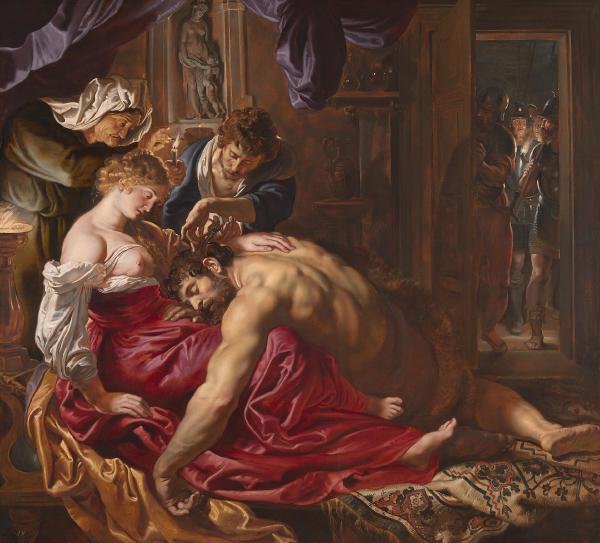
Samson wakes up in Judges 16 after Delilah has had his head shaved, says he’ll go out and shake himself free as he always has, and the narrator adds the line that ends his story: he did not know that the LORD had departed from him.
He did not know. That’s the whole tragedy of Judges 16. The thing that had been doing the work left silently while he slept, and he woke up and reached for it with complete confidence and found nothing there.
Saul’s case runs the opposite direction, and it is worse.
“But the Spirit of the LORD departed from Saul” (1 Samuel 16:14). Stated flatly, in the same construction. And unlike Samson, Saul is not operating under any illusion about his situation. He says it out loud at Endor. He can name the specific channels that have gone silent — prophets, dreams, and elsewhere the Urim (28:6). He has an inventory of his own condition.
Samson’s ignorance is pitiable. Saul’s clarity is something else entirely, because a man who knows exactly what has gone wrong and has full access to the remedy has already eliminated every excuse available to him.
He knew. And his response to knowing was to find a different channel.
What He Was Actually Looking For #
This is the part worth slowing down on, because it is almost always read backward.
Saul is not at Endor because he lacks information. He is not confused about God’s verdict on his kingship. That verdict was delivered publicly, years earlier, by Samuel, in daylight, with the prophet’s torn robe used as the visual aid: “The LORD hath rent the kingdom of Israel from thee this day, and hath given it to a neighbour of thine, that is better than thou” (1 Samuel 15:28).
He knows. He has known for years.
So when he asks the woman to bring up Samuel, he is not seeking new information. He is seeking a different authority to say the same thing — some source, any source, that might deliver a revised version of a verdict he has already received and refused to accept.
And notice what he gets. The apparition tells him the kingdom is torn from his hand and given to David, and cites Amalek as the reason (28:17-18). Compare that with chapter 15. It is the same verdict, in nearly the same words, with nothing added.
He went through enemy lines, at night, in disguise, to a practitioner he had outlawed on pain of death — and received a recitation of publicly available information he had been carrying for years.
The legitimate channel was closed. The alternative channel had nothing to offer but an echo.
He Outlawed This #
Two details in the account rule out any reading of Saul as confused or desperate-but-innocent.
First: “Saul had put away those that had familiar spirits, and the wizards, out of the land” (28:3). He had enforced the prohibition. The woman herself brings it up when a stranger asks her to conduct a séance — she assumes it’s a sting operation, because the man who banned her profession is still on the throne (28:9).
Second: “Saul disguised himself, and put on other raiment” (28:8).
He changed clothes. That is not the behavior of a man who doesn’t understand what he’s doing. It is the behavior of a man who understands precisely, knows it cannot be done openly, and does it anyway with his identity concealed.
There is no ignorance operating anywhere in this chapter. Everything Saul does at Endor, he does with full knowledge, having personally legislated against it, in a costume.
What the Woman Actually Saw #
Here is where the account becomes genuinely strange, and where careful reading matters more than familiar assumption.
Saul never sees anything.
Read the exchange: “And the king said unto her, Be not afraid: for what sawest thou?” (28:13). He has to ask her what she’s looking at. She describes an old man coming up, covered with a mantle. And then: “Saul perceived that it was Samuel” (28:14).
Perceived. Based on her description. Of a robe.
The identification is entirely secondhand, made by a man in the dark, on the word of a professional medium who has every commercial and personal incentive for him to believe her — and who has just realized that her client is the king who criminalized her trade, which is an excellent reason to give him precisely what he came for.
The apparition delivers nothing that wasn’t already public record. No new revelation, no information unavailable to the living, nothing that required a visit from the dead to obtain.
And Scripture supplies its own verdict on the whole event, in a passage nobody reads at Endor: “So Saul died for his transgression which he committed against the LORD, even against the word of the LORD, which he kept not, and also for asking counsel of one that had a familiar spirit, to enquire of it; and enquired not of the LORD” (1 Chronicles 10:13-14).
Read the last clause again. And enquired not of the LORD.
The inspired commentary on Endor says Saul did not inquire of the LORD that night — which is a peculiar thing for Scripture to assert if the LORD’s own prophet had in fact been summoned and had in fact answered him. Chronicles treats the consultation itself as one of the transgressions that killed him, not as a legitimate consultation that happened to deliver bad news.
The honest difficulty, which shouldn’t be smoothed over: the narrative in 1 Samuel 28 calls the figure “Samuel” four times, the woman does cry out when something appears (28:12), and the prediction about the following day proves accurate. None of that is decisive — the narrative frequently reports what participants perceived rather than adjudicating it, her outcry immediately precedes her recognizing Saul’s identity, and the prediction restates a judgment already pronounced. But the text is not as tidy as either side of this argument usually admits, and pretending otherwise would be dishonest.
What can be said with confidence is what Chronicles says: he inquired of a medium and did not inquire of God, and it cost him his life.
What Actually Closed the Channel #
Saul’s collapse has a stated cause, and Scripture is not vague about it.
He was told to wait seven days at Gilgal for Samuel. He waited, the people scattered, and on the seventh day he offered the burnt offering himself. Samuel arrived as he finished (1 Samuel 13:8-10).
He was told to destroy Amalek completely. He spared Agag and the best of the livestock, and when confronted, explained that the animals were preserved “to sacrifice unto the LORD thy God” (15:21).
Look at the shape of both failures. Saul did not abandon religion. At Gilgal he performed a sacrifice. At Amalek he preserved livestock for sacrifice. Every act of disobedience in his record is dressed in religious clothing and defended in religious language.
Which is what makes Samuel’s response the sentence the whole narrative turns on:
“Hath the LORD as great delight in burnt offerings and sacrifices, as in obeying the voice of the LORD? Behold, to obey is better than sacrifice, and to hearken than the fat of rams” (15:22).
The forms were intact. Saul kept every visible marker of a man in right standing with God — the altar, the offering, the vocabulary, the public religious performance. What he did not keep was the thing the markers existed to signify.
And this is precisely where he meets Samson.
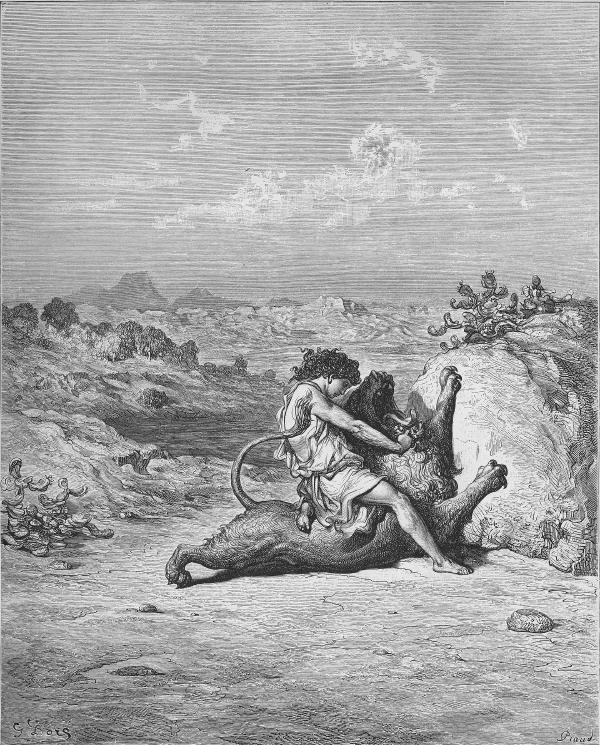
Samson kept the hair. Twenty years of it, uncut, the one visible sign of a Nazirite vow — while he ate honey scraped out of a corpse, killed a thousand men with a corpse’s jawbone, and spent his strength on whatever was right in his own eyes. The sign remained. The substance had been gone for decades. When they finally shaved his head, they were removing a marker that had long since stopped corresponding to anything.
Saul kept the sacrifices. Saul kept the throne, the armor, the army, the title. The marker remained. And on a specific day recorded in 1 Samuel 16:14, the substance left, and he stayed king for years afterward, fully equipped, fully credentialed, commanding an army, wearing a crown, with nothing behind any of it.
Two men. Two departures. One never noticed; the other diagnosed it correctly and went looking for a workaround.
The Night Before #
Saul’s last recorded act before the battle is to eat.
The woman he has just consulted sees him collapse on the ground, terrified and weak from fasting, and insists he eat something. She kills a calf, bakes unleavened bread, and sets it before him. He refuses, then relents. He eats, and he and his men get up and leave in the night (28:23-25).
That is the last domestic scene in Saul’s life. A medium feeding the king who outlawed her, in the dark, the night before he dies.
The next morning Israel breaks before the Philistines. Saul’s three sons are killed, including Jonathan. Saul is struck by archers, asks his armorbearer to finish him, is refused, and falls on his own sword (31:2-4). The Philistines cut off his head, strip his armor, and fasten his body to the wall of Beth-shan (31:9-10).
Everything the apparition said would happen, happened. It just hadn’t told him anything he didn’t already know.
The Question Underneath #
Saul’s problem was never a shortage of information.
He had a prophet. He had the Urim. He had dreams. He had a public, explicit verdict delivered years in advance with enough time to respond to it. He had the clearest possible diagnosis of his own condition, which he stated out loud, accurately, at Endor.
And when the channel went silent, he did not treat the silence as the thing it was — the consequence of a specific, named disobedience he had never actually addressed. He treated it as a technical problem. A connectivity issue. Something to be routed around by finding a different terminal.
That is the part that should be difficult to read. Not that Saul was ignorant. Not that he was deceived by a magic trick in a dark room, though he probably was. But that a man can know exactly what has gone wrong, be able to name it in a complete sentence, and still direct all of his energy toward obtaining a different answer rather than toward the obedience that closed the channel in the first place.
The silence was not the problem. The silence was the diagnosis.
He went looking for a second opinion.